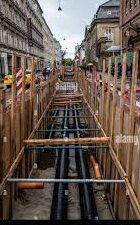
Underpinnning houses in Brantford matter. Six-foot ceilings, low joists, and crawlspace-feeling rooms that nobody actually spends time in. Underpinning changes that. By lowering the basement floor below the existing foundation, you turn unusable square footage into a real living space, an income suite, or a finished basement that adds genuine value to the home.
Delta Group handles underpinning in Brantford and across Brant County, working in established neighbourhoods where older homes have the kind of basements that need this work. Here’s what underpinning actually involves, what to expect in terms of cost and timeline, and how to pick a contractor who can do this technical work without destabilizing your house in the process.
Underpinning is the process of extending an existing foundation deeper into the ground so the basement floor can be lowered. It’s technical, specialized work that requires careful planning, engineering, and execution because you’re modifying the structure that’s holding up your entire house.
The process starts with engineering. A structural engineer designs the underpinning sequence based on the existing foundation, soil conditions, and the depth you want to achieve. The drawings specify how much new foundation to add, where to add it, and in what order. This is non-negotiable. Underpinning without engineered drawings is dangerous and illegal in Ontario.
Next comes the excavation. Crews dig sections of the existing foundation footing in small segments, called pins, typically three to four feet wide. Each pin gets excavated to the new depth, formed up, reinforced with rebar, and poured with concrete that bonds to the existing foundation above. The sequence matters: pins get done in a specific pattern that maintains structural support throughout the process. Doing too many adjacent pins at once causes settling or collapse.
Once all pins are poured and cured, the inside of the basement is excavated down to the new floor level. The new floor slab gets poured, waterproofing gets installed if required, and the space is ready for finishing.
The whole process typically takes three to six weeks for a standard residential underpinning, depending on the size of the basement and the depth being added.
Several scenarios in Brantford drive underpinning demand.
The most common reason. Older Brantford homes built before the 1960s often have basement ceilings of 6 to 6.5 feet, sometimes less. Code-compliant habitable basements need at least 6 feet 5 inches in most rooms, with some flexibility for beams and ducts. Many older Brantford basements miss this by a foot or more.
Underpinning to add 18 to 24 inches of depth transforms these spaces. A 6-foot basement becomes a 7.5 or 8-foot basement, which is genuinely usable for finished living space, rental suites, or home offices.
Brantford has been promoting secondary units as part of provincial housing intensification efforts. A finished basement with proper ceiling height, egress windows, and code compliance can become a legal second unit, which adds significant property value and rental income potential. Underpinning is usually a required step for older homes where the existing basement doesn’t meet code height requirements.
Some underpinning projects aren’t about lowering basements but about reinforcing failing foundations. Settling, cracking, or shifting foundations can be stabilized by underpinning sections to deeper, more stable soil. This is structural repair work that has to be engineered carefully.
Home additions in Brantford sometimes require underpinning the existing foundation to match the new addition’s foundation depth, particularly when adding a basement under what was previously a crawlspace or slab-on-grade portion of the home.
Brantford has a significant inventory of homes built between 1890 and 1960, particularly in neighbourhoods like the downtown core, Eagle Place, Holmedale, Echo Place, and parts of Terrace Hill. Many of these homes have full unfinished basements built to the standards of their era, which means low ceilings, stone or block foundations, and minimal moisture control.
These homes also tend to sit on lots and in neighbourhoods that command real market value when properly renovated. Adding a livable basement to a 1920s Brantford home in a desirable neighbourhood significantly improves the property’s value and utility, which is why underpinning has become a common renovation in this market.
The soil conditions in much of Brantford are reasonably favourable for underpinning, with stable clay and till underlying most residential areas. That said, every project needs a site-specific soil assessment before underpinning gets engineered.
Underpinning pricing varies based on several factors. Here’s what affects the total.
Depth being added. Lowering the basement by 12 inches is a different scope than lowering it by 24 or 36 inches. More depth means more excavation, more concrete, more time.
Total basement perimeter. A small bungalow’s basement perimeter is much shorter than that of a larger two-storey home’s. Underpinning is priced significantly based on the linear feet of foundation to be underpinned.
Soil conditions. Stable clay or till underpins well. Sandy, water-bearing, or unstable soils require more careful work, possibly dewatering, and sometimes shoring of adjacent sections during the work.
Existing foundation condition. A solid concrete foundation underpins more straightforwardly than crumbling stone or deteriorated block. Heavily damaged existing foundations may need more extensive work as part of the underpinning project.
Site access. How easily crews can move soil out and bring concrete in affects efficiency. Tight downtown Brantford lots with narrow side yards take longer than properties with good access.
Egress windows and code compliance. If underpinning is part of a broader basement legalization project, egress windows, proper exits, and other code compliance work add to the total project cost.
Waterproofing. Many underpinning projects in older Brantford homes include exterior or interior waterproofing as part of the work, since older foundations often have moisture issues. Adding waterproofing costs more but protects the new finished space long-term.
For typical Brantford residential underpinning, expect ranges between $30,000 and $80,000+, depending on the size of the basement and depth being added. Larger projects or those including additional structural work, waterproofing, and egress windows can run higher.
Underpinning requires a building permit through the City of Brantford’s Building Division. The permit application needs stamped engineered drawings showing the underpinning design, sequence, and structural specifications.
Underpinning also has to comply with Ontario Occupational Health and Safety Act requirements for excavation and confined space work, since crews are working in deep excavations under existing structures. You can review the relevant regulations through the Ontario Ministry of Labour’s construction projects regulations.
Inspections happen at multiple stages: footing/pin inspection before concrete pours, structural inspection of completed underpinning, and final inspection before the project closes. A contractor who works in Brantford regularly knows the local inspectors and the typical timeline.
If your underpinning project is part of a basement suite legalization, additional approvals through Brantford’s planning and zoning departments may be required.
Underpinning is not the same as foundation pouring or general concrete work. The sequencing, the structural risk, and the precision required make it a speciality work. A contractor whose main experience is driveways, patios, or new foundations isn’t qualified to underpin an existing structure. Ask specifically for underpinning project references and photos.
A proper underpinning project requires structural engineering. Your contractor needs to work directly with an engineer, build to the engineered drawings, and not deviate from the specified sequence. Contractors who suggest “we don’t really need an engineer for this” are red flags. The engineering is what keeps your house standing.
Underpinning carries real structural and safety risks. Your contractor needs significant general liability insurance (typically $5 million minimum), full WSIB coverage, and proper Occupational Health and Safety training for excavation and confined space work. Ask for certificates.
Underpinning involves excavation, concrete, structural work, and sometimes shoring. Contractors who subcontract pieces of this create coordination problems and reduce accountability when something goes wrong. A single contractor handling the full scope is significantly better.
A proper underpinning quote breaks out engineering, permits, excavation, concrete pin work, slab pour, waterproofing if included, and finishing details as separate line items. Lump-sum quotes hide cost shifts mid-project.
Some homes don’t need underpinning to get a usable basement. Bench footing, where a stepped concrete wall is built on top of the existing footing without going below it, may be sufficient if the existing ceiling is close to code. A good contractor explains both options honestly rather than pushing the more expensive underpinning when a bench footing would do.
Delta Group is based in Oakville and operates across southern Ontario, including Brantford and Brant County. We handle shoring, underpinning, demolition, excavation, concrete foundation, and site servicing work, which means we have the full range of capabilities needed for serious foundation projects in older homes.
Our underpinning services in Brantford include site assessment and structural engineering coordination, full sequenced pin underpinning, bench footing where appropriate, slab pour for the new lower floor, waterproofing integration, egress window installation if required, and full coordination with the City’s permit and inspection process.
Because we also handle excavation, shoring, and concrete foundation work in-house, complex underpinning projects that need additional related work (shoring during the dig, foundation repair beyond the underpinning, or full basement remediation) get one team and one quote instead of separate contractors who don’t coordinate well.
We build to the engineered drawings, work to code, and give you a clear quote with itemized scope. The number you sign for is what you pay unless the scope genuinely changes.
Planning to lower your basement, add a secondary unit, or repair a settling foundation in Brantford? Call us at 905-849-9900 or reach out through our website. We’ll walk the property, review your goals, and put together a detailed proposal that reflects the actual scope of the work.
Delta Group serves Brantford, Hamilton, Burlington, Oakville, Waterloo, Kitchener, Cambridge, and the surrounding southern Ontario region.
Check out our shoring page, Click Here!
Work With Us — Click Here!
Follow our Instagram, Click Here!