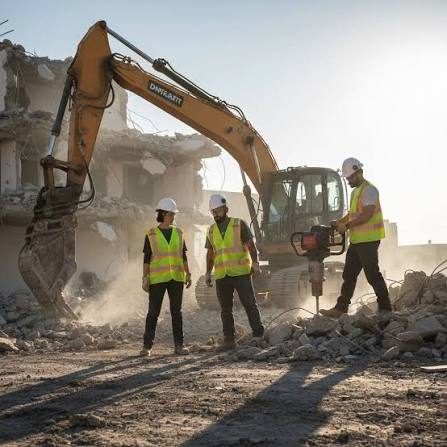
Hiring a demolition contractor in Mississauga usually means you’re at the start of something bigger. An old bungalow in Mineola is coming down for a custom build, or a commercial unit needs gutting before a new tenant moves in. Either way, the demo sets the pace for everything that follows. A slow, sloppy teardown pushes your whole schedule back before construction even starts.
Delta Group handles residential and commercial demolition across Mississauga. We’re based next door in Oakville, so this is home turf for us. Here’s what the process looks like, what the City requires, and what to check before you sign with anyone.
The teardown itself is the easy part. Most of the real work happens before the excavator shows up.
Every job starts with a site walk. We look at the structure, flag likely hazardous materials, check where utilities run, and figure out how the work affects the neighbours. Mississauga’s older neighbourhoods have mature trees and homes sitting close to the lot line, so this step matters.
Then come the permits. The City of Mississauga issues demolition permits through its Building Division. Properties near the Credit River or other regulated creeks may also need Credit Valley Conservation sign-off.
Utilities have to be cut before any work begins. That means Alectra for hydro, Enbridge for gas, the Region of Peel for water and sewer, and the telecom providers. Utility timelines are the most common reason demolition schedules slip, so we book these early.
After that, the structure comes down. We sort the material for recycling, haul it to licensed facilities, and leave the lot clean and ready for the next trade.
This is the bulk of residential demo work in the city. Older homes in Mineola, Lorne Park, Port Credit, Erindale, and Streetsville keep getting replaced with larger custom builds. A full teardown removes everything above grade. The foundation comes out too when the lot needs to be fully clear for the new build.
Some projects only need part of the house removed. That could be clearing space for an addition, removing a garage, or stripping the interior down to the studs. Selective demo takes more care than a full teardown because the parts that stay have to come through undamaged.
Mississauga has a huge commercial and industrial base. Retail plazas, office tenant improvements, and warehouse clear-outs along the 401 and 403 corridors all generate steady demo work. Commercial jobs usually run on tighter timelines, and the crew often has to work around businesses that stay open next door.
We also remove detached garages, sheds, decks, and in-ground pools. These are smaller jobs, but they still need permits and licensed disposal.
A Mississauga demolition permit application needs a site plan, confirmation that utilities are disconnected, and proof of insurance. Older buildings also need a designated substance survey before the permit is issued. The survey checks for asbestos, lead, mercury, and silica. A lot of Mississauga’s housing stock dates from the 1950s through the 1970s, so asbestos turns up often in insulation, flooring, and plaster.
Ontario requires licensed abatement of these materials before demolition can start. You can see the full list of regulated substances on the Ontario Ministry of Labour’s designated substances page.
Trees are the other common snag. Mississauga protects private trees above a certain size. Removing or damaging one without a permit can halt your project and bring fines.
A standard Mississauga house teardown typically runs between $15,000 and $35,000. These are the factors that move the number:
Size and construction type. A brick two-storey costs more to bring down than a wood-frame bungalow.
Hazardous material abatement. Asbestos removal can add anywhere from a few thousand dollars to $40,000 or more, depending on how much is found.
Foundation removal. Pulling out the foundation usually adds $5,000 to $15,000.
Site access. Narrow lots and tight streets slow the work and increase cost.
Disposal fees. Tipping fees have risen across the GTA. Sorting material for recycling helps offset this on larger jobs.
Permits and tree protection. These are small line items, but a proper quote includes them.
Insurance and WSIB. Ask for certificates up front. Commercial work typically needs $5 million in liability coverage.
Mississauga permit experience. Contractors who work here regularly know the Building Division, Peel’s utility process, and the CVC requirements. That knowledge saves weeks.
An itemized quote. The quote should show permits, abatement, demolition, foundation removal, and disposal as separate lines. A single lump-sum number makes it easy for costs to grow mid-job.
Their own crew and equipment. Contractors who subcontract the actual demo work have less control over your schedule.
A protection plan. Ask how they’ll protect trees, fences, and neighbouring homes during the work. A vague answer is a warning sign.
Most Mississauga teardowns are the first stage of a custom build. We handle demolition, shoring, excavation, concrete foundations, and site servicing in-house. That means one team carries your project from the old house coming down to the new foundation going in.
On tight lots in Mineola or Port Credit, having one crew own that whole sequence removes most of the coordination problems that come with hiring four separate contractors. One schedule, one point of contact, one quote. The price you sign is the price you pay unless the scope genuinely changes.
Planning a teardown, partial demo, or commercial strip-out in Mississauga? Call us at 905-849-9900 or reach out through our website. We’ll walk the site and give you a clear, itemized quote.
Delta Group serves Mississauga, Oakville, Burlington, Toronto, Brampton, Hamilton, Milton, and the surrounding GTA.
Looking for a demolition contractor in Mississauga? Click here