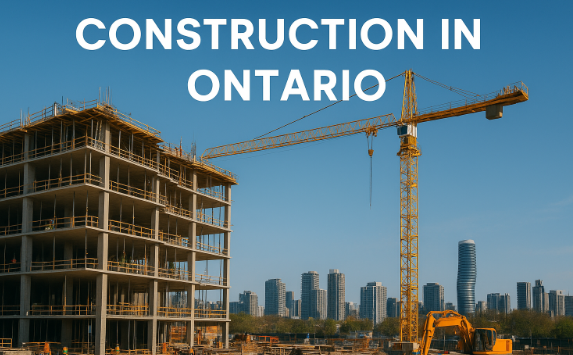
Construction in Ontario: Trends, Challenges, and Opportunities in 2025
Construction in Ontario continues to be one of the province’s most important economic drivers, shaping the way communities grow, businesses expand, and infrastructure evolves. From new residential developments to large-scale industrial projects, the demand for skilled labour, modern technology, and efficient building practices has never been higher. In this blog, we break down the major trends, challenges, and opportunities shaping construction in Ontario today.
Ontario’s construction industry is thriving due to strong population growth, increased immigration, and rising demand for housing and infrastructure. Cities like Toronto, Mississauga, Ottawa, and Hamilton are experiencing rapid expansion with transit lines, high-density residential towers, and commercial developments. Key drivers of growth include housing demand, government investment, and industrial expansion. This growth ensures that construction in Ontario remains a long-term opportunity for companies, tradespeople, and investors.
AI, automation, drone surveying, BIM modelling, and project-management software are becoming standard. These tools reduce errors, cut project costs, and improve scheduling accuracy.
Ontario faces a shortage of skilled workers such as electricians, plumbers, machine operators, and carpenters. This shortage increases wages and competition among employers.
Green construction is becoming standard. Builders use eco-friendly materials, energy-efficient systems, and renewable-energy integrations to meet Ontario’s environmental goals.
Modular methods improve speed and reduce waste. More Ontario developers are adopting prefab elements for residential, commercial, and institutional projects.
The industry is growing quickly but faces challenges including rising material costs, permit delays, regulatory complexity, construction site safety concerns, supply chain disruptions, and labour shortages. Companies adapt through alternative materials, stronger training programs, and new scheduling strategies.
Opportunities include infrastructure megaprojects, commercial fit-outs, residential developments driven by immigration, energy-efficient retrofits, and increasing demand for construction technology. Firms that innovate and invest in their workforce are positioned for long-term success.
The future of construction in Ontario will be shaped by technology adoption, sustainability, and workforce development. Companies that embrace digital tools, enhance training, and build energy-efficient structures will remain competitive as the province continues to expand.
To Learn more, Click Here!
Visit our site! Click Here!